
Being good at the job is not the same as leading the people who do it.
THE GAP
FOUNDED ON EXPERIENCE. VALIDATED BY RESEARCH.
I'm a graduate of the FBI National Academy, one of the most respected leadership programs in the world, and I hold a master's degree in Administrative Leadership from the University of Oklahoma.
For twenty-three years I was also a training executive. I rewrote more than sixty-five policies and SOPs and led my organization through a multi-year culture-change project culminating in state accreditation. Developing people and building systems that hold under pressure has been my actual work for decades.
I've also worked inside Fortune 100 and Fortune 500 organizations, I'm the author of The Art of Trust and Influence, and I speak on leadership internationally. So I understand and empathize with the world and the challenges that you and your managers walk into every day.
THE FRAMEWORK


Four. On purpose.
There’s real research behind that number. George Miller’s work back in 1956, and more recent neuroscience out of MIT, puts the working limit of human memory at about four things. A model with thirty-two competencies looks impressive on a slide. But if your managers can’t hold it in their head when the pressure is on, they can’t use it. Four is what a person can actually carry into a hard moment and act on.
There’s a similar pattern in the research on goals. A Harvard Business School paper called Goals Gone Wild shows what happens when people chase too many targets at once. Progress stalls across all of them. Focus on fewer, and the odds of real change go up.
So four isn’t a shortcut. It’s just how people actually learn and change.
WHERE TO BEGIN
You can't close a gap you can't see.
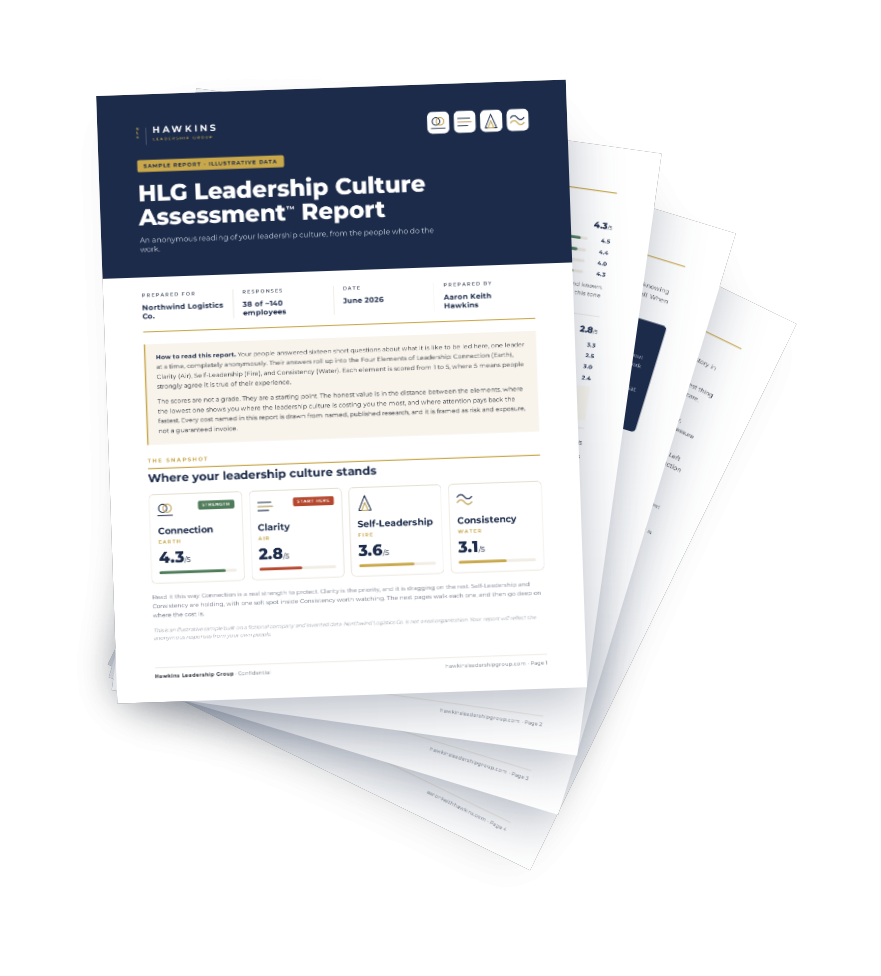
WHAT YOU RECEIVE
The real goal of leadership development was never to have managers finish a program. It’s to have leaders whose teams do the right thing when no one is watching.
I learned this lesson most vividly during my fifteen years as a SWAT operator. In my early years, our team leader made it clear what our standards were, what our objectives were, and why they mattered. And there were days he wasn’t there. On many of those days we ran our longest, hardest training sessions. Not because someone made us. Because we understood the assignment, we agreed it mattered, and we were committed to it ourselves.
No matter the industry or profession, there's a big difference between a team that complies and a team that commits.
THE STANDARD
The below definition is what leadership looks like when it is fully embedded into the culture. It is the standard everything here is built to reach.
Leadership is a collection of actions that result in the understanding, agreement, and ongoing pursuit of an objective, regardless of the presence or absence of someone in a position of authority.
For your organization, it’s the difference between a team that needs constant managing and a team that manages itself. One drains your best leaders. The other frees them. Every stage below builds toward that, and the free assessment shows you how close you already are.
THE PATH
Leadership culture moves through stages. The first step is confirming which one you're currently in.
WHAT CLOSES THE GAP
MOST PEOPLE START HERE
See what your people see.