

THE CASE FOR FOUR
Why Four (And Not Thirty-Two)
There's a real difference between a framework that looks thorough and one that actually works.
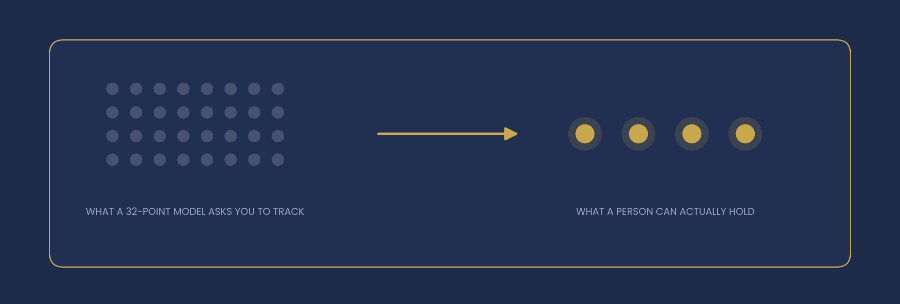
A lot of leadership development programs tend to compete on volume. The common assumption is that the more skills, diagrams, and matrices a leader can track and improve, the better their leadership should be. It sounds logical. But there's a problem with this logic. The mind can't hold thirty-two things at once, so when a leader is faced with a couple dozen items to track and improve, they often end up acting on exactly none of them.
The research is settled on this. Early work, going back to George Miller's 1956 paper in Psychological Review, suggested we could hold around seven things in mind at a time. More rigorous studies since (Nelson Cowan's review of the working-memory literature, and neuroscience research out of MIT published in PNAS in 2011) have revised that down. The real working limit is closer to four.
The same pattern shows up in behavior change. Focus on fewer goals and you're more likely to reach them. Spread your effort across many and they compete for the same limited time and attention, and progress stalls on all of them. The Harvard Business School working paper Goals Gone Wild documents the side effects of piling on too many goals (narrowed focus, reduced learning, eroded performance), and the research is consistent across the field.
So a thirty-two point (or similar) model fails twice. You can't hold it, and even if you could, you'd dilute yourself trying to work on everything at once.
Four is different. Four is about what a person can carry, come back to when the pressure is on, and actually do something with. That's why the framework has four elements. Not because leadership is simple, but because this is how people actually learn and change.